LED Pool Lamps Compliance Europe: CE & ErP Requirements Guide
LED Pool Lamps Compliance Europe: CE & ErP Requirements Guide
Selling LED pool lighting in Europe involves more than adding a CE logo to a product or obtaining a laboratory report. Manufacturers, importers, distributors and project buyers need to determine which EU requirements apply to the specific configuration being placed on the market.
That distinction matters because an underwater LED lamp, its external driver, an RGB/RGBW controller and a wireless control module may not have exactly the same regulatory obligations.
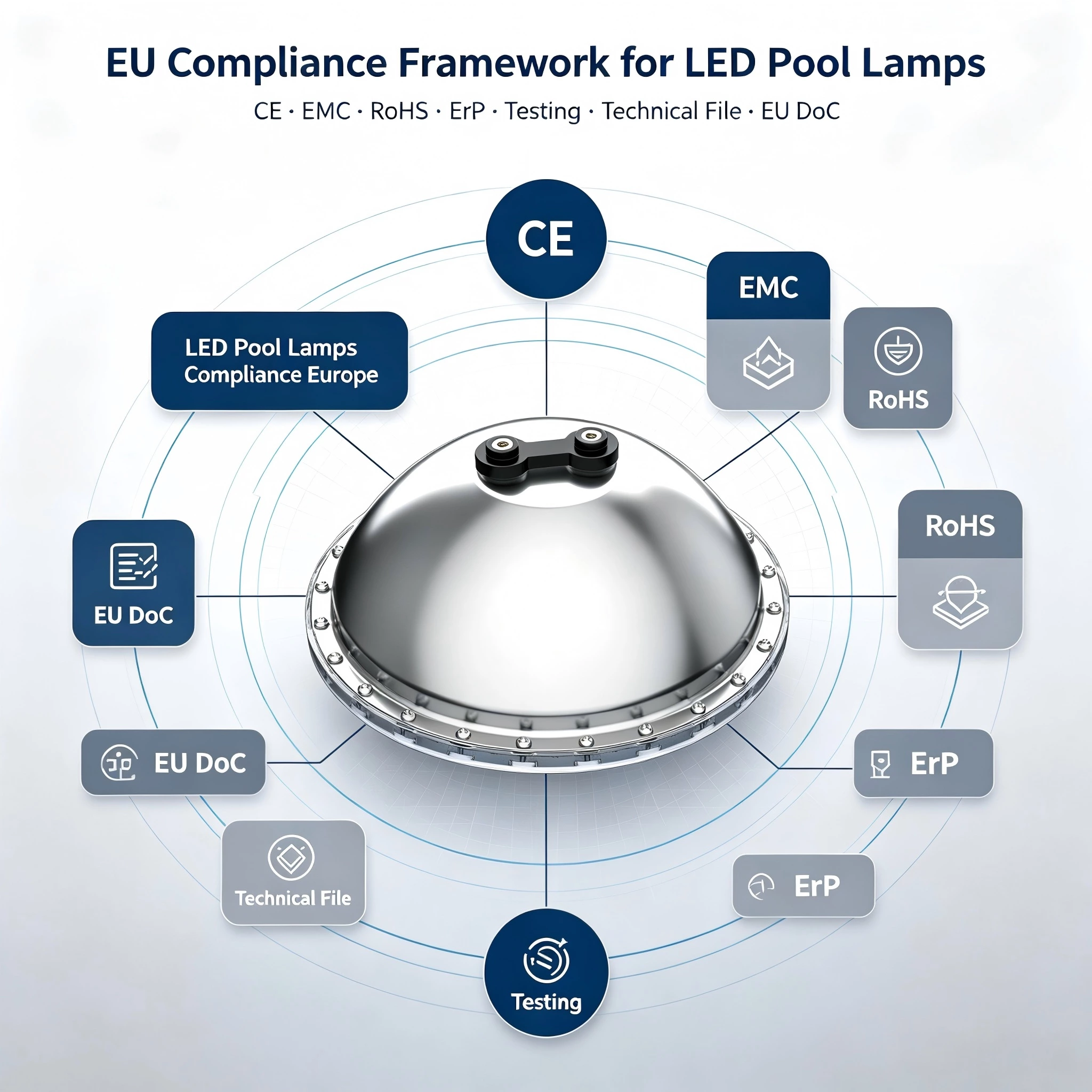
This LED pool lamps compliance Europe guide explains the major compliance areas manufacturers and buyers should evaluate, including CE marking, electromagnetic compatibility (EMC), RoHS, electrical safety, ErP ecodesign requirements, energy labelling and EPREL.
Last regulatory review: September 2026
Table of Contents
- What Does LED Pool Lamps Compliance in Europe Mean?
- Which EU Regulations Apply to LED Pool Lamps?
- CE Marking Requirements for LED Pool Lights
- ErP Ecodesign Requirements for LED Pool Lamps
- Energy Labelling and EPREL: Does Your Pool Lamp Need Registration?
-
RoHS, EMC and Electrical Safety Requirements
What Does LED Pool Lamps Compliance in Europe Mean?
LED pool lamps compliance Europe refers to the process of determining and meeting the EU requirements applicable to an LED pool-lighting product before it is placed on the European market.
It is not a single test or certificate.
Depending on the product, compliance can involve several layers: applicable EU legislation, conformity assessment, technical documentation, product testing, an EU Declaration of Conformity (DoC), CE marking and, where applicable, ecodesign or energy-labelling obligations.
CE Marking Is a Declaration, Not a Generic EU Certificate
A common sourcing misconception is that a manufacturer simply sends a pool light to a laboratory and receives a universal "CE certificate."
That is not how the EU CE framework works.
The manufacturer is responsible for identifying applicable EU legislation, verifying product-specific requirements, completing the appropriate conformity assessment, preparing technical documentation, issuing the EU Declaration of Conformity and affixing the CE marking where required.
Third-party testing can provide critical evidence within that process, but a laboratory report should not be confused with the manufacturer's overall legal responsibility for conformity.
Think in Terms of a Compliance System
For an LED swimming-pool light, the compliance map can include:
- CE marking — where applicable EU harmonisation legislation requires it.
- EMC — electromagnetic emissions and immunity requirements for relevant electronic equipment.
- RoHS — restrictions on certain hazardous substances in electrical and electronic equipment within scope.
- Electrical safety — including assessment of the product's operating voltage, driver and overall configuration.
- ErP/ecodesign — requirements for in-scope light sources and separate control gears.
- Energy labelling and EPREL — where the product qualifies as an in-scope light source under the applicable rules.
- Technical documentation — evidence showing why the product conforms to the applicable requirements.
A Practical Configuration Example
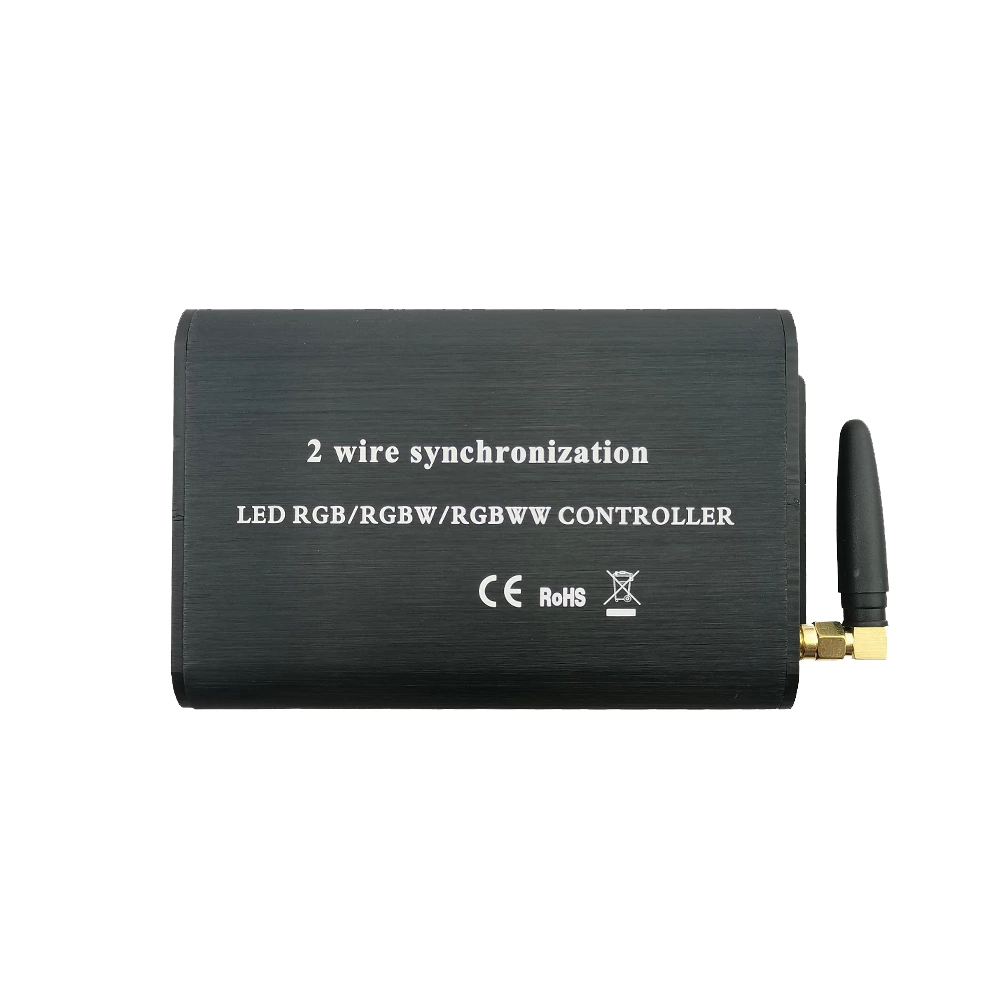
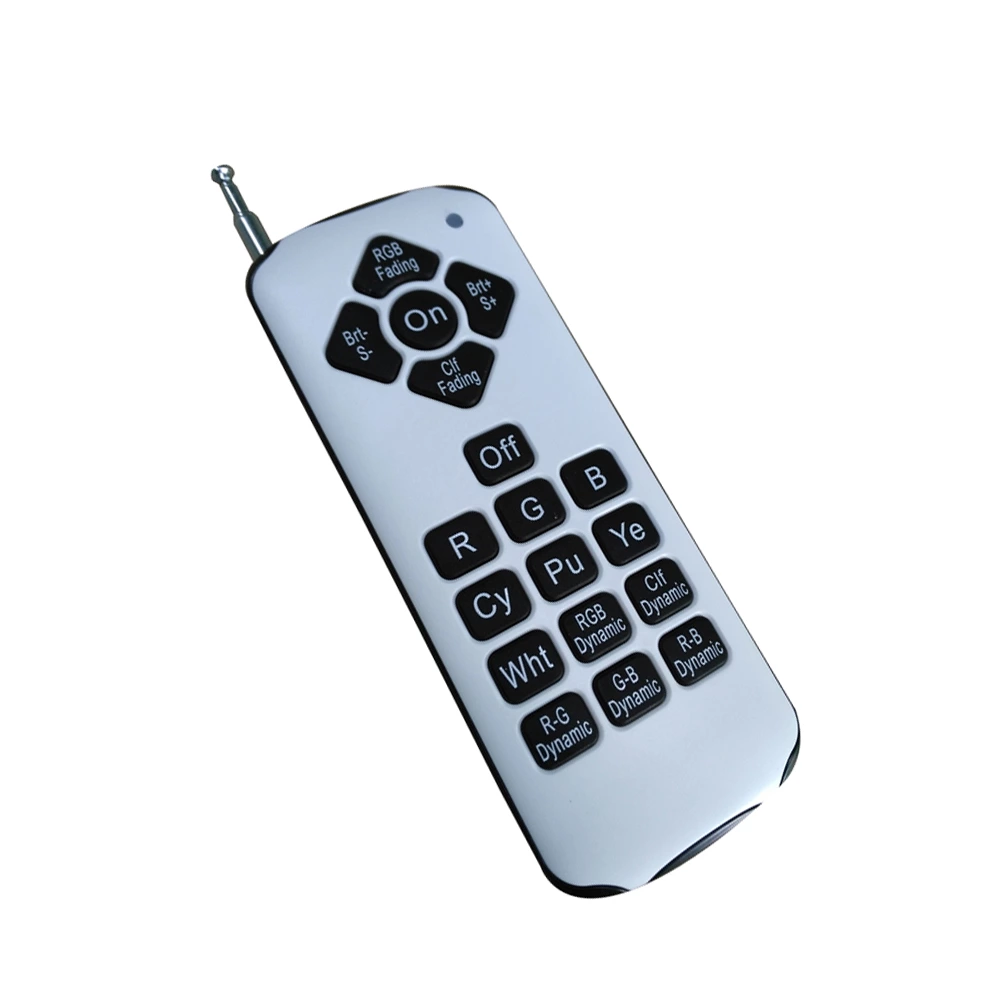
Consider a 24 V DC underwater RGBW pool lamp supplied with a separate AC/DC power supply and a wireless RGBW controller.
A manufacturer should not automatically treat the complete package as one regulatory object.
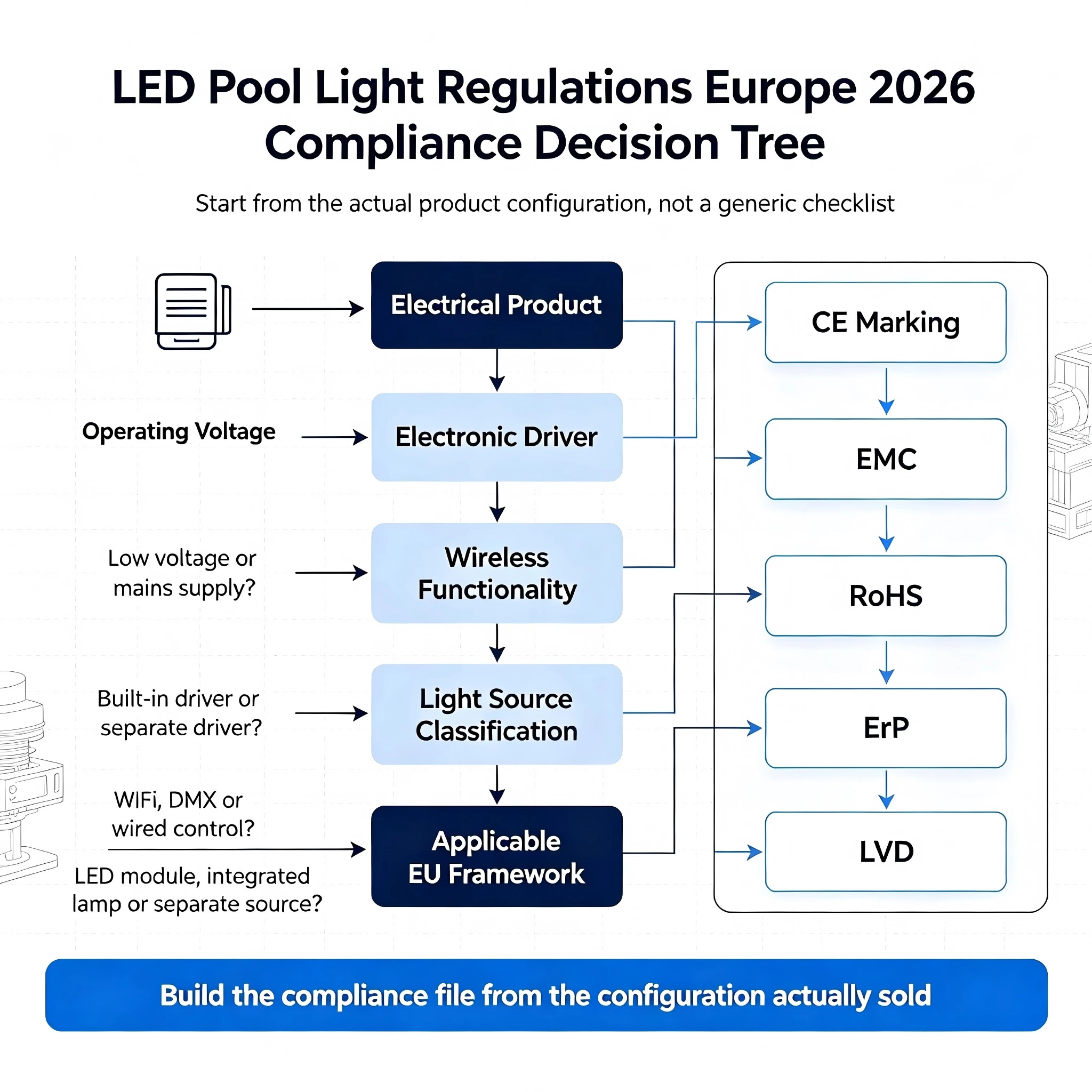
Instead, the compliance team should map the system:
- Assess the underwater lamp and its electrical/electronic characteristics.
- Assess the external power supply or control gear.
- Determine whether the controller introduces additional EMC or other regulatory requirements.
- Determine whether wireless functionality changes the applicable regulatory framework.
- Classify the relevant lighting components under the current ecodesign and energy-labelling rules.
- Build technical documentation that clearly connects the final marketed configuration to the supporting evidence.
This product-by-product approach is the foundation of a reliable EU LED pool lighting compliance guide.
Regulatory Overview
Table: LED pool lamps compliance Europe — regulatory overview
| Requirement | Main Purpose | Typical Relevance | Typical Evidence |
|---|---|---|---|
| CE marking | Demonstrate conformity with applicable EU harmonisation requirements | Products covered by legislation requiring CE marking | EU DoC + technical documentation |
| EMC | Electromagnetic compatibility | Relevant electronic equipment | Assessment/test evidence |
| RoHS | Restriction of hazardous substances | Electrical/electronic equipment within scope | Material declarations and/or testing evidence |
| ErP/Ecodesign | Energy and resource performance | In-scope light sources/control gear | Product and test data |
| Energy labelling | Energy information for covered light sources | In-scope light sources | Label, product information and EPREL data where required |
Which EU Regulations Apply to LED Pool Lamps?
There is no reliable one-line answer to the question, “Which LED pool light regulations Europe 2026 requirements apply?”
The correct approach is a regulatory-scope assessment based on the actual product.
A low-voltage underwater lamp with an external driver can have a different compliance map from a mains-powered product. Adding a wireless controller can change that map again.
EMC Directive 2014/30/EU
The EMC Directive addresses electromagnetic compatibility.
For relevant electronic pool-lighting equipment, manufacturers need to evaluate whether the product can operate without generating unacceptable electromagnetic disturbance and whether it has adequate immunity to electromagnetic disturbances expected in its intended environment.
This can be particularly relevant to:
- LED drivers;
- dimming electronics;
- RGB and RGBW controllers;
- switching power supplies;
- electronic control modules; and
- complete electronic lighting assemblies.
A change to a driver or controller can therefore be more than a purchasing change. It may affect the technical basis on which EMC conformity was established.
Low Voltage Directive 2014/35/EU
The Low Voltage Directive (LVD) applies within its defined voltage scope.
That makes product architecture especially important for pool lighting. A 12 V or 24 V underwater lamp should not automatically be treated in the same way as a mains-voltage power supply feeding it.
The lamp, external driver and complete marketed system should be assessed separately against the scope and requirements of the applicable legislation.
RoHS Directive 2011/65/EU
RoHS restricts specified hazardous substances in electrical and electronic equipment within its scope.
For an LED pool-light manufacturer, compliance management may involve more than a single finished-product test. A robust process can include supplier declarations, component information, bill-of-materials controls, material risk assessment and appropriate analytical evidence.
Ecodesign Regulation (EU) 2019/2020
The EU's lighting ecodesign framework establishes requirements for light sources and separate control gears within its scope.
The key question is therefore not simply, “Is this a pool light?”
The manufacturer needs to determine how the marketed product is classified under the regulation—for example, whether relevant components constitute a light source, separate control gear or part of a containing product, and whether any applicable special provision or exemption changes the obligations.
Energy Labelling Regulation (EU) 2019/2015
EU energy-labelling rules establish labelling and supplementary product-information requirements for covered light sources.
Where a product falls within scope, the compliance workflow can include energy-efficiency classification, required product information and EPREL obligations.
It would nevertheless be misleading to state that every LED pool light automatically needs the same energy label or EPREL registration. Classification must come first.
What About Connected Pool Lights?
Connectivity deserves a separate check.
A conventional single-colour low-voltage lamp and a remotely controlled connected RGBW lighting system do not necessarily present the same regulatory profile.
When Bluetooth, Wi-Fi, RF or another communications function is introduced, the manufacturer should reassess the complete applicable legal framework rather than assuming that an existing non-connected product's compliance documentation automatically covers the new model.
LED Pool Light Regulatory Mapping Matrix
| EU Requirement | Product Feature Trigger | Lamp | Driver | Controller | Key Documentation | Verification Needed |
|---|---|---|---|---|---|---|
| EMC | Electronic/electrical functionality within scope | Check | Check | Check | Assessment/test reports | Yes |
| LVD | Product falls within defined voltage scope | Check | Often relevant depending on design | Check | Safety evidence | Yes |
| RoHS | EEE within scope | Check | Check | Check | Material/BOM evidence | Yes |
| ErP | In-scope light source/control gear | Check | Check | Depends on classification | Performance data | Yes |
| Energy labelling | In-scope light source | Check | Usually classification-dependent | Usually classification-dependent | Label/product data | Yes |
| Additional connected-product rules | Wireless/data functionality | If connected | If connected | Potentially significant | Additional conformity evidence | Yes |
CE Marking Requirements for LED Pool Lights
Understanding the CE marking requirements for LED pool lights begins with understanding what CE marking represents.
The CE mark indicates that the manufacturer declares conformity with applicable EU requirements that provide for CE marking. It should be the result of the required conformity-assessment process—not the starting point.
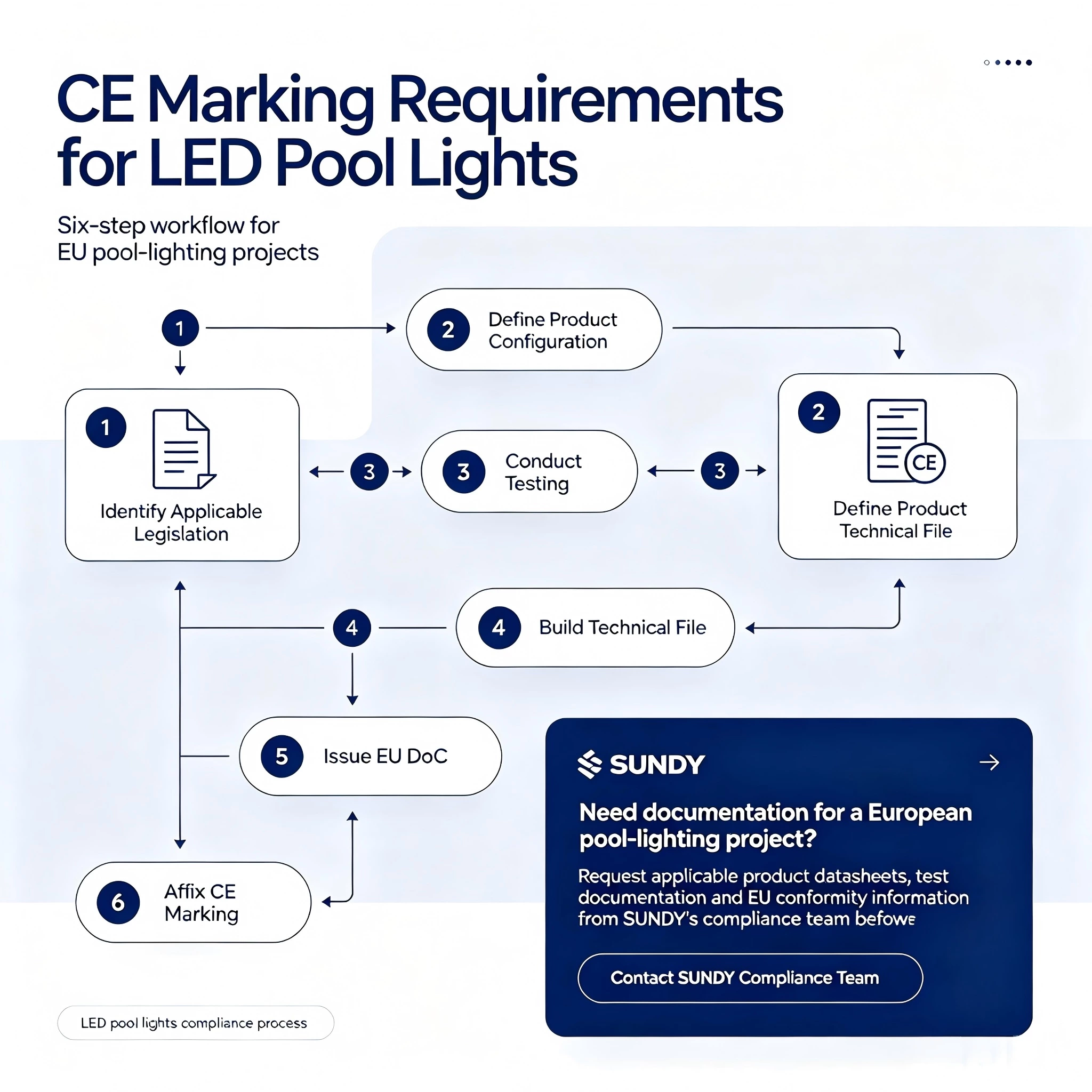
How to Comply With EU LED Pool Lamp Regulations: The CE Workflow
A practical process can be organized into six stages.
1. Identify Applicable EU Legislation
Start with the exact product configuration and identify every relevant EU directive or regulation.
Questions include:
- What voltage does the product use?
- Is the driver internal or external?
- Does it contain electronic control circuitry?
- Does it communicate wirelessly?
- Is it sold as a lamp, a kit or part of a larger system?
- Which lighting-product classification applies?
This scope assessment determines what happens next.
2. Identify Relevant Standards and Technical Requirements
After identifying applicable legislation, determine which harmonised standards or other technical specifications can be used to demonstrate conformity.
Standards are not interchangeable with legislation. The compliance file should document why the selected standards and assessment methods are relevant to the particular product.
3. Perform the Required Assessment and Testing
Testing should match the compliance claims being made.
Depending on the product, evidence can include electrical-safety assessments, EMC results, substance-compliance documentation, photometric measurements and ecodesign performance data.
Testing an early prototype does not automatically demonstrate that later production units remain identical to the tested configuration.
4. Compile the Technical Documentation
The technical file should allow the conformity of the product to be assessed.
Typical contents can include:
| Document | Purpose | Prepared/Controlled By | Before Market Entry? | Typical Update Trigger |
|---|---|---|---|---|
| Product/risk assessment | Identify applicable risks and requirements | Engineering/compliance | Yes | Design or regulatory change |
| Test reports | Provide conformity evidence | Lab + manufacturer | Yes | Component/design change |
| Drawings and BOM | Define tested product configuration | Engineering | Yes | Component revision |
| Standards list | Record assessment basis | Compliance | Yes | Standard update |
| EU DoC | Manufacturer's conformity declaration | Manufacturer | Yes | Applicable compliance change |
| Labelling records | Show product/packaging markings | Quality/compliance | Yes | Label or regulatory change |
| Instructions | Communicate installation and safety information | Engineering/technical writing | Yes | Product/application change |
5. Issue the EU Declaration of Conformity
Where required, the manufacturer draws up and signs the EU Declaration of Conformity.
The DoC needs to correspond to the actual product and applicable legislation. Copying a declaration from a superficially similar model creates obvious traceability and compliance risks.
6. Affix the CE Marking
Only after the relevant requirements have been addressed should CE marking be affixed in accordance with the applicable rules.
The European Commission describes the manufacturer as responsible for conformity assessment, technical documentation, the EU Declaration of Conformity and CE marking.
Manufacturer, Importer and Distributor Responsibilities
European compliance does not stop at the factory.
The manufacturer carries the primary responsibilities associated with product design and conformity. Importers and distributors also have obligations under the applicable EU product framework and should not assume that a CE logo on a carton is sufficient evidence.
For a commercial buyer, useful due-diligence questions include:
- Can the supplier provide the EU Declaration of Conformity?
- Does the model number match the product being purchased?
- Which legislation and standards are listed?
- Are the supporting reports applicable to the same construction?
- Are the driver and controller included in the assessed configuration?
- Have important components changed since testing?
Five Common CE Documentation Problems in Pool-Light Sourcing
1. The model on the test report does not match the purchased model.
Family reports can be legitimate, but the relationship between models should be technically justified and documented.
2. The power supply changes without compliance review.
Changing a driver can affect safety, EMC and performance characteristics.
3. “CE certificate” is treated as the entire compliance file.
A laboratory document cannot replace the manufacturer's complete conformity process.
4. The EU DoC lists outdated or irrelevant legislation.
Declarations need active document control.
5. Product changes are not reflected in technical documentation.
A compliance file should describe the production configuration, not an obsolete prototype.
When Is a Notified Body Required?
CE marking does not automatically mean a notified body must issue a certificate.
The applicable legislation determines the conformity-assessment route and whether third-party/notified-body involvement is required. Manufacturers should determine this during the initial regulatory mapping rather than purchasing a generic “CE certification” package without first establishing its legal relevance.
ErP Ecodesign Requirements for LED Pool Lamps
The ErP requirements for LED pool lamps are part of the EU's broader ecodesign framework for energy-related products.
For lighting, Commission Regulation (EU) 2019/2020 establishes ecodesign requirements for light sources and separate control gears and also addresses those placed on the market within containing products.
This is another area where product classification matters.
First Determine What the Product Is
Before applying performance thresholds or documentation requirements, determine whether the relevant product is classified as:
- a light source;
- a separate control gear;
- a component within a containing product; or
- a product or application subject to another relevant provision or exemption.
This step can materially change the compliance pathway.
For example, a low-voltage LED pool lamp that depends on external control gear cannot simply be assessed from its retail name. Its electrical and physical architecture needs to be mapped against the definitions in the regulation.
Performance Data Must Be Controlled
Depending on classification and applicability, ecodesign assessment can involve parameters such as:
- declared power;
- useful luminous flux;
- energy performance;
- control-gear efficiency;
- standby power;
- networked standby power for connected products where applicable;
- colour characteristics;
- lumen-maintenance/lifetime-related parameters; and
- required product information.
The relevant requirements should always be taken from the current legal text applicable to the product rather than from an old generic lighting checklist.
Example: Organizing an LED Pool Lamp Family
Suppose a manufacturer offers a family of visually similar underwater lamps at 6 W, 12 W, 18 W and 24 W.
The compliance team should create a controlled dataset connecting each declared model to:
- electrical input characteristics;
- LED and driver configuration;
- measured power;
- photometric performance;
- applicable test reports;
- declared values used in product literature; and
- the corresponding technical-file records.
If RGB and RGBW variants use materially different electronics or optical configurations, the manufacturer should determine whether the existing evidence adequately represents those variants rather than assuming that the same data applies.
Engineering Data and Marketing Data Must Agree
A frequent compliance-management weakness is inconsistent data.
The catalogue might state one wattage, the laboratory report another, the product label a third, and an online listing a fourth.
A controlled compliance system should establish one approved set of declared values and propagate those values across technical documentation, labels, datasheets and relevant regulatory databases.
ErP Technical Data Table
| Parameter | Regulatory/Technical Basis | Test Evidence | Declared Value | Documentation Location |
|---|---|---|---|---|
| Input/declared power | Applicable ErP requirements | Electrical test data | Per model | Datasheet + technical file |
| Useful luminous flux | Applicable measurement method | Photometric report | Per model | Technical file |
| Energy performance | Product classification-dependent | Calculation/test | Per model | Technical file |
| Stand |